Preached at the Kitkin’ o’ the Tartans at St. James’ Episcopal Church, Springfield, MO, 4 November 2023
Psalm 138 & 139; Revelation 7:4-17; Matthew 13:31-35
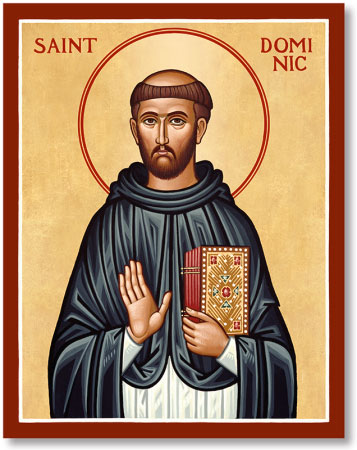
For those of you who don’t know me, I am Br. Mike Malone, and I am not a monk. I’m not clergy, not a priest or a deacon. I am a friar. I am a life-professed member of the Anglican Order of Preachers, the Anglican expression of Dominican spirituality. Most people In the Episcopal Church don’t even know that we even HAVE religious orders. And most people here in the Bible Belt don’t seem to know what a religious order IS. Sometimes I will jokingly tell people outside the Episcopal Church that I’m in a cult. It does get their attention.. If you’d like to hear more about religious orders in the Episcopal Church, I’d be happy to speak to you about them later or give you my email address.
I would like to thank Fr. Petty for allowing me to deliver the homily this evening. If you’re not Episcopalian, you may not know that the rector of a parish pretty much has veto power over anything regarding services. And Fr. Petty doesn’t KNOW me. I’m guessing he went strictly on Bob Lanning’s recommendation. Unless, of course, he got a recommendation from a certain FORMER rector who is now the Episcopal Bishop of Idaho and, coincidentally, the new Bishop-Visitor for my Order.
Whenever I start working on a homily for a special day like this, the first thing I always want to do it find an endpoint — some basic truth that I need to bring to the pulpit. For a service like this, of course, it really needs to relate to something specifically SCOTTISH. Of course, preachers always go — in the Anglican tradition, anyway — to the scriptures for the day. Tonight we are using something called the Daily Office Lectionary. It’s a plan of set scriptures for each day of the week that cycles through most of the Bible — with a few exceptions — over the course of two years. What I do is try to find something in one of the readings that you can apply to the day or special service being celebrated; in this case, a festival of Scottish clans. At first I thought Fr. Petty had thrown me a curve ball, but it turned out to be easier than I expected.
In tonight’s passage from the Revelation to St. John we read:
“After this I looked, and there was a great multitude that no one could count, from every nation, from all tribes and peoples and languages, standing before the throne land before the Lamb, robed in white…”
And so I want to talk to you for a few minutes about some of that ”great multitude.” I want to talk about those who have gone before us: specifically, Scottish saints. A Wikipedia listing of the Saints of Scotland lists no fewer than 64 saints, most of whom I’ve never heard of, and I don’t expect you have either.
Some of our best saints weren’t even Scottish, but they ministered in Scotland. Take St. Columba, an Irish monk who was instrumental in being Christianity to Scotland. Evidently a LOT of Irish monks came to Scotland. This speaks to my heart, since although part of my heritage is Irish, I found out recently that more than 50% of my DNA is Scottish. Or we could speak of St. Margaret, whom we have celebrated before at this gathering. She was born into the English royal family, but married King Malcolm III of Scotland, and is known for her charities to the poor. Or St. Cuthbert, a very important saint from the 7th century on. He was technically Anglo-Saxon, but was born in Dunbar, Northumbria. That area is now in Scotland, so I think we can claim him.
But we can claim as our own, too, such saints as William of Perth, the patron saint of adopted children. A baker by trade, he was martyred while on a pilgrimage to holy sites. We can claim St. Fillan of Pittenweem, a 6th-century monk who was active in the area around Fife.
There are more. For some of them we have little information. I’m sure there are some whose names have been completely lost. A lot has been lost. Great spans of time and a few invasions will do that sort of thing. But many of them are still held up as examples to live by. I am reminded of a passage from a book in the Apocrypha, the Wisdom of Ben Sira, also known as Ecclesiaticus:
Let us now sing the praises of famous men,
our ancestors in their generations.
The Lord apportioned to themgreat glory,
his majesty from the beginning.
There were those who ruled in their kingdoms
and made a name for themselves by their strength;
those who gave counsel because they were intelligent;
those who spoke in prophetic oracles;
those who led the people by their counsels
and by their knowledge of the people’s lore;
they were wise in their words of instruction;
those who composed musical tunes
or put verses in writing;
rich men endowed with resources,
living peacefully in their homes—
all these were honored in their generations
and were the pride of their times.
Some of them have left behind a name,
so that others declare their praise.
But of others there is no memory;
they have perished as though they had never existed;
they have become as though they had never been born,
they and their children after them.
But these also were men of compassion
whose righteous deeds have not been forgotten;
their wealth will remain with their descendants
and their inheritance with their children’s children.[c]
Their descendants stand by the covenants;
their children also, for their sake.
Their offspring will continue forever,
and their glory will never be blotted out.
Their bodies are buried in peace,
but their name lives on generation after generation.
Every year we get together here at St. James to celebrate our Scottish heritage. I don’t know how long this has been done in Springfield. Todd Wilkerson can probably tell you. But I’ve been a part of maybe 5 or 6 celebrations here at St. James and participated in one or two before that at St. John’s Episcopal Church across town. It had a little hiatus during the height of the COVID epidemic, but it has been done often enough that I believe it’s become a tradition here, and that’s not a bad thing. In fact, I think it’s a very GOOD thing.
Tradition, as someone once said, is giving the dead a vote. And by holding this celebration every year we are giving those who have gone before us their due. We celebrate them as our progenitors. We celebrate them as our fathers and mothers in faith. We are, in essence, giving them a vote as to how we live our lives now. Some of them became famous and we remember their names. Others, as Ben Sira said, are gone as if they had never been.
In the first verse of Chapter 12 of the Letter to the Hebrews we find,
Therefore, since we are surrounded by so great a cloud of witnesses, let us also lay aside every weight and the sin that clings so closely and let us run with perseverance the race that is set before us.
We have all these Saints of Scotland watching us, the ones we know by name and the ones we do not. How will we live? Will we live up to their example in faith, the example of those who have gone before? Will we run the race with perseverance?
There is a hymn in our Episcopal Hymnal, a children’s hymn about the Saints of God. It’s sung less often these days than it once was — it’s kind of quaint, and the words are VERY British — but it’s beloved, especially by many older Episcopalians. In fact, it was almost removed from our current hymnal but was kept by popular demand. The first verse goes like this:
I sing a song of the saints of God, patient and brave and true
Who toiled and fought and lived and died
For the lord they loved and knew
And one was a doctor, and one was a queen
And one was a shepherdess on the green
They were all of them saints of God, and I mean
God helping, to be one to.
It’s the last verse, though, that, even with its peculiarly British viewpoint really sums up how we should think about saints:
They lived not only in ages past;
There are hundreds of thousands still
The world is bright with the joyous saints
Who love to do Jesus’ will.
You can meet them in school, or in lanes, or at sea,
In church, or in trains, or in shops, or at tea;
For the saints of God are just folk like me,
And I mean to be one too.
You don’t have to be famous to be a saint. You don’t have to move mountains. Someone once said, “I cannot do all the good the world needs, but the world needs all the good I CAN do.” You don’t have to be a Margaret, or a Cuthbert, or an Aidan. For the saints of God are just Scots like me, and I mean to be one too.
I hope you will join me.
Amen.

 Becoming Dominican