Revelation 7:9-17; Psalm 34:1-10, 22; 1 John 3:1-3; Matthew 5:1-12
You would think that writing a sermon for All Saints’ would be a piece of cake. I mean, it’s not Trinity Sunday, is it? Trinity is traditionally the Sunday that rectors go on vacation and leave the sermon to an associate, curate, deacon, or lay preacher, who then spends sleepless nights trying to thread the needle between saying something profound but orthodox and something heretical. Let’s face it: Try to delve into the meaning of the Trinity and it’s pretty much impossible not to commit one heresy or another.
All Saints’ is different, but still a little difficult. The readings seem so sweet and nice. It’s tough to find any thing with any teeth in it for a sermon.
Let’s take a look…
The first two are great! The reading from the Revelation of John, which we have in place of an Old Testament reading, gives us a picture of the saints triumphant! Yay! Hooray, we’ll possess the kingdom! We win!
The second reading gives us even more to look forward to. When God is revealed, we’ll be like Him. Yay! We’ll be like God, we win again!
Then there’s the Gospel reading.
The Gospel for today is the Beatitudes, as found in Matthew. These are found both in Mathew and Luke, part of the Sermon on the Mount in Matthew and the Sermon on the Plain in Luke – even the Gospel writers couldn’t agree on where it took place.
Now, at first glance, it seems like another “Yay! We’re gonna finally get what we deserve!” passage. But congratulating ourselves is not what the Beatitudes are about. Especially in Luke. And I am going to use the passage as it is in Luke, because in Luke they are both an encouragement and a challenge. For Luke especially, they’re rules for self-examination.
The version from Matthew, as we read today, gives us “Blessed are the poor in spirit…” and “Blessed are those who hunger and thirst after righteousness...” Matthew’s Beatitudes have a very spiritual focus, and that’s fine. But Luke’s concerns aren’t really focused on spiritual well-being. They’re physical and immediate. And in Luke, unlike in Matthew, Jesus adds some warnings, commonly known as the “woes,” because they all begin “woe to you…”.
What does the world expect us to strive for? Do we work to be rich? To be well fed? To make ourselves happy? To gain the approval of others? But these things we work so hard for are only temporary. Jesus says, “if you’re comfortable now, good for you. Enjoy it. It won’t last, and then you’ll be like those less fortunate folks over there.”
In Matthew, we can make believe this is all about US, Luke doesn’t give us that option.
Which do we need to hear? The blessings? Or the woes?
The Beatitudes are often considered words of comfort, and they are comforting to those of us going through hard times. But they are also words of challenge to those of us who have resources. If we see someone who needs that blessing that is described, what do we do? Do we try to provide money, food, or consolation? Do we actually show them the Kingdom of God? Or do we just tell them to buck up, that things will be better…someday? Do we help them when it’s convenient, when we have a few extra bucks or maybe an hour or two to spare?
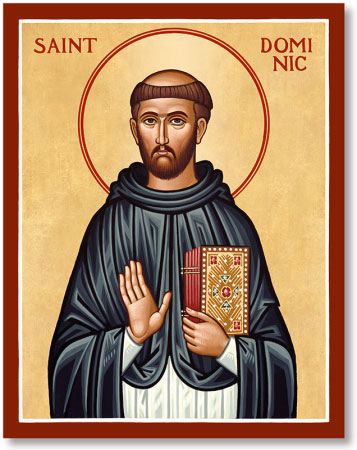
The Beatitudes have always had a special meaning for Dominicans.
The Greek word that both Luke and Matthew use in this speech, μακάριοι (makarioi), can mean “blessed” or “rich”, but it can also mean “happy,” and the early Dominicans took the “happy” part seriously. So seriously, in fact, that they were often criticized by the monastic orders for being too…happy. Having now spent several annual Chapter meetings as an Anglican Dominican and several days with the Roman Catholic Dominicans in St. Louis, I can say with some certainty that Dominicans still consider the “happy” part really important. But Dominicans consider the challenge of the Beatitudes just as important. It’s how you share your joy with others.
This Tuesday, November the Third, is the feast day of St. Martin de Porres, who just happened to be a Dominican saint. There is a shrine to him in Memphis that you can visit. As a matter of fact, a bunch of us Dominicans will be there in January. Martin is a wonderful example of the Beatitudes in action.
Martin was the son of a Spanish nobleman and a freed black slave, born in Lima, Peru, in 1579. Because he was, in the terms of the time, a “mulatto,” he was barred by law from becoming a full member of any religious order. At the age of 15 he was received as a servant at the Dominican Convent of the Rosary, in Lima. When Martin was 24 the prior essentially ignored the law and allowed Martin to become a lay brother.
Martin was always ready to put others’ needs over his own. When the convent was in financial need, he suggested that they sell him. He worked in the infirmary from the time he took vows until his death, and when an epidemic struck, he went to the quarantined parts of the convent to serve the sick novices there.
He ministered to everyone who needed his help: to African slaves and to the Spanish nobility. He made no distinctions. He begged enough money to feed about 160 people every day and still handed out money to the poor. He even defied his own prior. The story is told of Martin finding an Indian with a knife wound and taking him to his own room in the convent until he could take him to a hospice, something that was not allowed. The Prior reprimanded him, but Martin said “Forgive my error, and please instruct me, for I did not know that the precept of obedience took precedence over that of charity.” After that, the prior – wisely — allowed him to follow his conscience.
So go figure. He was poor, and yet he gave money and food away. He took care of everyone. That, my friends, is how the Kingdom of God works. That is how people see it working.
And that is what the Beatitudes are all about.
Jesus was never one to tell people to sit back and watch or to tell others to sit back and watch. In order to come true, the Beatitudes must be put into action. The popular sentiment “Let go and let God” just doesn’t jibe with Jesus’ message unless it’s amended to “Let go and let God use you in service of His kingdom.” In order to make the Beatitudes real, we are the ones who should be going out to people in need and addressing those needs. Just reading the blessings and sitting back thinking “oh, how nice” doesn’t cut the mustard.
But what if we could do even better than helping those in need? Could we change the conditions that put these people in need in the first place? Could those of us who enjoy privilege, who have resources, change things? In the words of Archbishop Desmond Tutu, “We need to stop pulling people out of the river. We need to go upstream and find out why they’re falling in.”
We might never reach the point where no one is hungry, no one is poor, but shouldn’t we at least try?
Because that trying is the real meaning of All Saints Day. We look at people like Martin de Porres and see what they had to work with, and we have to wonder why we aren’t doing the same things they did. Or, at least trying. It’s the trying that’s important. That’s what how the Kingdom of God breaks in. People will see it. People will want to be a part of it. And the cool thing is, the people who work toward the Kingdom of God are some of the happiest people you will ever meet.
Amen.


